Wikipedia and the Representation of Reality
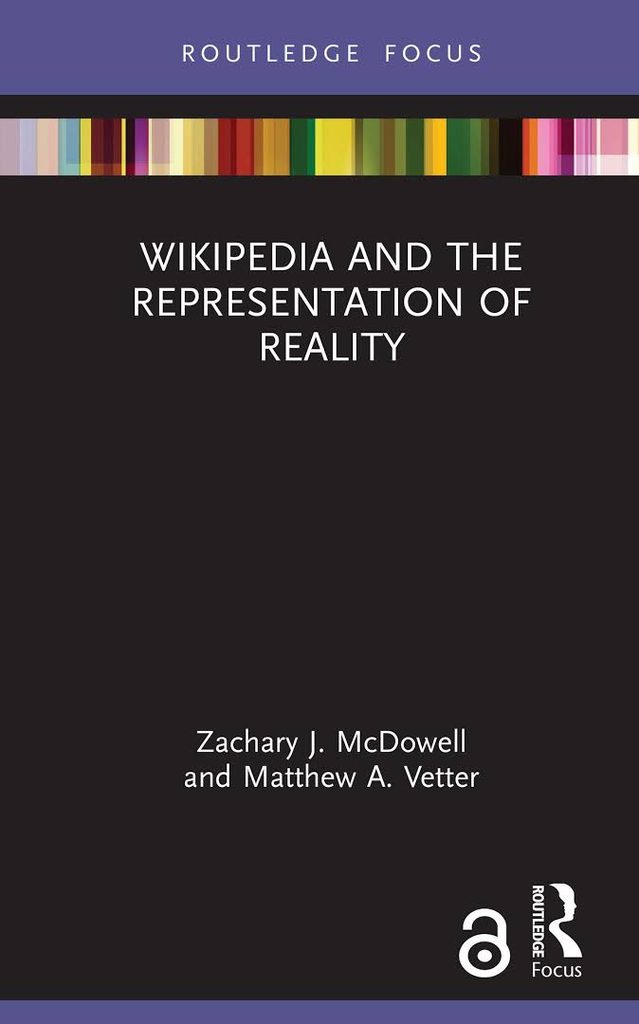
McDowell, Zachary J. and Matthew A. Vetter. Wikipedia and the Representation of Reality. Routledge, 2021. https://doi.org/10.4324/9781003094081.
Brief abstract: Bridging contemporary education research that addresses the ‘experiential epistemology’ of learning to use Wikipedia with an understanding of how the inception and design of the platform assists this, the book explores the complex disconnect between the encyclopedia’s formalized policy and the often unspoken norms that govern its knowledge-making processes. At times both laudatory and critical, this book illustrates Wikipedia’s struggle to combat systemic biases and lack of representation of marginalized topics as it becomes the standard bearer for equitable and accessible representation of reality in an age of digital disinformation and fake news.
Writing Spaces: Readings on Writing
WRITING SPACES is an open textbook project for college-level writing studies courses. Each volume in the Writing Spaces: Readings on Writing series contains peer-reviewed collections of essays about writing—all composed by teachers for students—with each book available for download for free under a Creative Commons license from the Writing Spaces website and the WAC Clearinghouse and in low-cost printed versions from Parlor Press.
Writing Spaces: Readings on Writing offer multiple perspectives on a wide-range of topics about writing, much like the model made famous by Wendy Bishop’s “The Subject Is . . .” series. In each chapter, a rich variety of authors will present their unique views, insights, and strategies for writing by addressing the undergraduate reader directly. Drawing on their own experiences, these teachers-as-writers will invite students to join in the larger conversation about developing nearly every aspect of their craft. Consequently, each essay will function as a standalone text which will easily complement other selected readings in writing or writing-intensive courses across the disciplines at any level. Thus with your submissions and the publication of subsequent volumes of essays, the Writing Spaces website will become a large library of student-centered instructional essays on writing for all across our field to use in the composition classroom.
Driscoll, Dana, Stewart, Mary, Heise, Megan, and Matthew A. Vetter, eds. Writing Spaces: Readings on Writing. Vol. 4. Parlor Press & WAC Clearinghouse, 2021. https://wac.colostate.edu/books/writingspaces/writingspaces4/.
Driscoll, Dana, Stewart, Mary, Heise, Megan, and Matthew A. Vetter, eds. Writing Spaces: Readings on Writing. Vol. 4. Parlor Press & WAC Clearinghouse, 2021. https://wac.colostate.edu/books/writingspaces/writingspaces4/.
Driscoll, Dana, Mary Stewart, and Matthew Vetter, eds. Writing Spaces: Readings on Writing. Vol. 3, Parlor Press & WAC Clearinghouse, 2020. https://wac.colostate.edu/books/writingspaces/writingspaces3/.
Peer-Reviewed Scholarly Articles
[34] Lucia, Brent, Jiang, Jialei, Farag, Islam, and Matthew A. Vetter. Navigating the AI Writing Assistant: Disclosure, Trust, and Learning Among Business Undergraduates. Journal of Business and Technical Communication. Forthcoming April 2027 issue (41.2).
[33] Vetter, Matthew A., Farag, Islam, Jiang, Jialei, Lucia, Brent, and John J. Silvestro. The Hidden Cost of Disclosure: A Multi-institutional Study on Undergraduate Students’ Generative AI Usage and Faculty Accusations. Educational Policy. Forthcoming.
[31] Lucia, Brent, Vetter, Matthew., & Patel, Varshil. (2025). The Dystopian Imaginaries of ChatGPT: A Designed Cycle of Fear. Convergence: The International Journal of Research into New Media Technologies, 31(4), 1233-1250. https://doi.org/10.1177/13548565251333212
[30] Vetter, Matthew A., Jiang, Jialei, and Zachary J. McDowell. (2025) “An Endangered Species: How LLMs Threaten Wikipedia’s Sustainability.” AI & Society. https://doi.org/10.1007/s00146-025-02199-9
[29] Jiang, Jialei, Lucia, Brent, and Matthew A. Vetter. (2024) “From Hype to Practice: Reinterpreting the Writing Process through Technical Writing Students’ Engagement with ChatGPT.” Technical Communication Quarterly. https://doi.org/10.1080/10572252.2024.2445302
[28] Jiang, Jialei, Vetter, Matthew A., and Brent Lucia. “Toward a ‘More-Than-Digital’ AI Literacy: Reimagining Agency and Authorship in the Postdigital Era with AI Text Generators.” Postdigital Science & Education, 2024. https://doi.org/10.1007/s42438-024-00477-1
[27] Yim, Andrew, Vetter, Matthew A., and Jun Akiyoshi. “I Don’t Feel Like It Is ‘Mine’ at All”: Assessing Wikipedia Editors’ Sense of Individual and Community Ownership.” Written Communication, vol. 41, no. 3, 2024. https://doi.org/10.1177/07410883241242103
[26] Vetter, Matthew A., Jiang, Jialei, Othman, Mahmoud, and Mercy Muguimi. “Navigating the Emotional Terrain of Wikipedia Writing: A Feminist Affective Analysis of Student Writers’ Engagement with the ‘Be Bold’ Guideline. Computers and Composition, vol. 72, 2024, https://doi.org/10.1016/j.compcom.2024.102850
[25] Vetter, Matthew A., Lucia, Brent, Jiang, Jialei, and Mahmoud Othman. “Towards a Framework for Local Interrogation of AI Ethics: A Case Study on Text Generators, Academic Integrity, and Composing with ChatGPT.” Computers and Composition [Special Issue on “Composing with AI”], vol. 71, 2024, https://doi.org/10.1016/j.compcom.2024.102831.
[24] Brent Lucia, Matthew A. Vetter & David A. Solberg. “‘I Feel Like I’m in a Box’: Contrasting Virtual Reality ‘Imaginaries’ in the Context of Academic Innovation Labs.” Technical Communication Quarterly, 2023. https://doi.org/10.1080/10572252.2023.2245442
[23] Lucia, Brent, Vetter, Matthew A., and Isaac Adubofour. “Behold the Metaverse: Facebook’s Meta Imaginary and the Circulation of Elite Discourse.” New Media & Society, 2023. https://doi.org/10.1177/14614448231184249
[22] McDowell, Zachary J., and Matthew A. Vetter. “The Re-Alienation of the Commons: Wikidata and the Ethics of “Free” Data.” International Journal of Communication. 2024. https://ijoc.org/index.php/ijoc/article/view/20807/4453
[21] Vetter, Matthew A., and Zachary J. McDowell. “A Spectrum of Surveillance: Charting Functions of Epistemic Inequality Across EdTech Platforms in the PostCovid Era.” Journal of University Teaching & Learning Practice, vol. 20, no. 2, February 2023, https://doi.org/10.53761/1.20.02.02.
[20] McDowell, Zachary J., and Matthew A. Vetter. “Fast ‘Truths’ and Slow Knowledge; Oracular Answers and Wikipedia’s Epistemology.” Fast Capitalism, vol. 19, no. 1, November 2022, https://doi.org/10.32855/fcapital.202201.009.
[19] Vetter, Matthew A., et al. “Assessing the Art + Feminism Edit-a-Thon for Wikipedia Literacy, Learning Outcomes, and Critical Thinking.” Interactive Learning Environments, vol. 30, no. 6, July 2022, pp. 1155–67, https://doi.org/10.1080/10494820.2020.1805772.
[18] McDowell, Zachary J., and Matthew A. Vetter. “Wikipedia as Open Educational Practice: Experiential Learning, Critical Information Literacy, and Social Justice.” Social Media + Society, vol. 8, no. 1, 2022, https://doi.org/10.1177/20563051221078224.
[17] Vetter, Matthew A., Brent Lucia, and Oksana Moroz. “The Rhetoric of Locative Media: A Discursive/Material Look at Google Lens.” Rhetoric Review, vol. 40, no. 1, 2021. https://doi.org/10.1080/07350198.2020.1841452.
[16] Xing, Jiawei and Matthew A. Vetter. “Editing for Equity: Understanding Instructor Motivations for Integrating Cross-disciplinary Wikipedia-based Assignments.” First Monday, vol. 25, no. 6, 2020. https://doi.org/10.5210/fm.v25i6.10575.
[15] Vetter, Matthew A. “Broadening Representations of Rhetoric in Wikipedia: Disciplinary Praxis as Graduate Pedagogy.” Studies in Higher Education, vol. 45, no. 5, 2020. https://doi.org/10.1080/03075079.2020.1749798.
[14] McDowell, Zachary J., and Matthew A. Vetter. “It Takes a Village to Combat a Fake News Army: Wikipedia’s Community and Policies for Information Literacy.” Social Media + Society, vol. 6, no. 3, 2020, p. 205630512093730, https://doi.org/10.1177/2056305120937309.
[13] Jiang, Jialei and Matthew A. Vetter. “A Feminist Rhetorical approach to Wikipedia-based Writing Instruction in First-Year Composition Classrooms.” Composition Forum, vol. 45, 2020. http://compositionforum.com/issue/45/wikipedia.php.
[12] Vetter, Matthew A., and Oksana Moroz. “Wikipedia-based Education for First Year Composition.” Composition Studies, vol. 47, no. 2, 2019. https://compstudiesjournal.com/issues/current-issue-fall-2019-47-2/.
[11] Jiang, Jialei and Matthew A. Vetter. “The Good, the Bot, and the Ugly: (Mis)Information and Critical Media Literacy in the Postdigital Era.” Postdigital Science and Education, vol. 2, 2019. https://doi.org/10.1007/s42438-019-00069-4.
[10] Vetter, Matthew A., Zachary McDowell, and Mahala Stewart. “From Opportunities to Outcomes: The Wikipedia-based Writing Assignment.” Computers and Composition, vol. 51, 2019. https://doi.org/10.1016/j.compcom.2019.01.008.
[9] Vetter, Matthew A., John Andelfinger, Shahla Asadolahi, Wenqi Cui, Jialei Jiang, Tyrone Jones, Zeeshan Siddique, Inggrit Tanasale, Jiawei Xing, and Ebenezer Ylonfoun. “Wikipedia’s Gender Gap and Disciplinary Praxis: Representing Women Scholars in Digital Rhetoric and Writing Fields.” Journal of Multimodal Rhetorics, vol. 2, no. 2, 2018. http://journalofmultimodalrhetorics.com/2-2-vetter-et-al.
[8] Vetter, Matthew A. “Teaching Wikipedia: Appalachian Rhetoric and the Encyclopedic Politics of Representation.” College English, vol. 80, no. 5, 2018, pp. 397-422. https://www.jstor.org/stable/26773390.
[7] Vetter, Matthew A., and Matthew Nunes. “Writing Theory for the Multimajor Professional Writing Course.” Pedagogy, vol. 18, no. 1, 2018, pp. 157-173. https://doi.org/10.1215/15314200-4217010.
[6] Vetter, Matthew A., Theresa McDevitt, Dan Weinstein and Ken Sherwood. “Critical Digital Praxis in Wikipedia: The Art+Feminism Edit-a-thon.” Hybrid Pedagogy, 2017. https://hybridpedagogy.org/wikipedia-art-feminism-edit-a-thon/.
[5] Vetter, Matthew A., and Keon Pettiway. “Hacking Hetero/Normative Logics: Queer Feminist Media Praxis in Wikipedia.” Technoculture, vol. 7, 2017. https://tcjournal.org/vol7/hacking-hetero-normative-logics.
[4] Vetter, Matthew A. “Archive 2.0: What Composition Students and Academic Libraries Can Gain from Digital-Collaborative Pedagogies.” Composition Studies, vol. 42, no. 1, 2014, pp. 35-53. https://eric.ed.gov/?id=EJ1031809.
[3] Vetter, Matthew A. “Queer the Tech: Genderbending and Anti-Consumer Activism in Social Media.” Harlot: A Revealing Look at the Arts of Persuasion, vol. 11, 2014. http://harlotofthearts.org/index.php/harlot/article/view/195/148.
[2] Vetter, Matthew A., and Sara Harrington. “Integrating Special Collections into the Composition Classroom: A Case Study of Collaborative Digital Curriculum.” Research Library Issues, vol. 283, 2013. https://doi.org/10.29242/rli.283.4.
[1] Vetter, Matthew A. “Composing with Wikipedia: A Classroom Study of Online Writing.” Computers and Composition Online, 2013. http://candcblog.org/mvetter/public_html/composingwithwikipedia/.
Book Chapters
[7] Vetter, Matthew A. “Knowledge Equity Strives for Universal Access and Participation in Human Knowledge.” Digital Literacies for Human Connection: 25 Ways to Engage Students in People-Centered Digital Practices, edited by David Coad, Rich Shivener, and Amber Buck. NCTE, 2026. 208-216
[6] Vetter, Matthew A. and Oksana Moroz. “You are Good for Wikipedia.” Writing Spaces: Readings on Writing, Volume 6, edited by Trace Daniels-Lerberg, Dana Driscoll, Mary Stewart, and Matthew Vetter, Parlor Press, 2023.
[5] Vetter, Matthew A.. “Collaboration.” In J. Tham (Ed.), Keywords in Design Thinking: A Primer ForMakers, Designers, & Technical Communicators. Parlor Press, 2023. https://doi.org/10.37514/TPC-B.2022.1725.2.08
[4] Heise, Megan and Matthew A. Vetter. “Centering Translingualism in Multimodal Practice: A Reflective Case Study of a Linguistically Diverse Graduate Program.” Professionalizing Multimodal Composition, Eds. Shyam Pandy and Santosh Khadka. Utah State U P, 2023.
[3] Jiang, Jialei and Matthew A. Vetter. “Writing against the ‘Epistemology of Deceit’ on Wikipedia: A Feminist New Materialist Perspective Towards Critical Media Literacy and Wikipedia-based Education.” The Epistemology of Deceit in a Postdigital Era: Dupery by Design, Eds. Alison MacKenzie, Jennifer Rose, and Ibrar Bhatt. Springer, 2021. https://doi.org/10.1007/978-3-030-72154-1_9.
[2] Vetter, Matthew A. “Possible Enlightenments: Wikipedia’s Encyclopedic Promise and Epistemological Failure.” Wikipedia @ 20: Stories of an Incomplete Revolution. Eds. Joseph Reagle and Jackie Koerner. MIT Press. https://doi.org/10.7551/mitpress/12366.003.0024.
[1] Vetter, Matthew A., and Cori Woods. “The Wikipedia Edit-a-Thon for Critical Information Literacy and Public Service.” Library Service and Learning: Empowering Students, Inspiring Social Responsibility, and Building Community Connections. Eds. Theresa McDevitt and Caleb Finegan, Association of College and Research Libraries (ACRL), 2018. http://www.worldcat.org/oclc/1086477735.
Reviews
Vetter, Matthew A. “Giota Alevizou, The Web of Knowledge: Encyclopedias and Authority in the Digital Age” [Review]. International Journal of Communication, vol. 20, 2026. https://doi.org/10.65476/6m9r5d24.
Vetter, Matthew A. “Webtext of the Month: ‘Let Me Queer My Throat’” Review of “Let Me Queer My Throat: Queer Rhetorics of Negotiation: Marriage Equality and Homonormativity,” by Hillery Glasby.” Digital Rhetoric Collaborative, University of Michigan Press/University of Michigan Center for Writing, 2014. https://www.digitalrhetoriccollaborative.org/2014/11/18/webtext-of-the-month-let-me-queer-my-throat/.
Non-Refereed & Popular Writing
Vetter, Matthew A. “Why You Need to Understand Wikidata, No Matter What Field You’re In.” Wiki Education Blog. 21 Dec., 2021. https://wikiedu.org/blog/2021/12/21/why-you-need-to-understand-wikidata-no-matter-what-field-youre-in/
McDowell, Zachary J. and Matthew A. Vetter. “Seeing the world like Wikipedia: What you should know about how the world’s largest encyclopedia works.” LSE Impact Blog. Nov 18, 2021. https://blogs.lse.ac.uk/impactofsocialsciences/2021/11/18/seeing-the-world-like-wikipedia-what-you-should-know-about-how-the-worlds-largest-encyclopedia-works/
Vetter, Matthew A., and Veronica Paz. “Using LittleBits Robot Kits to Sponsor Community Building and Student Engagement Across Campus.” IUP Center for Teaching Excellence Blog, IUP, 19 Nov., 2018, iblog.iup.edu/ctebloggers/2018/11/19/using-littlebits-robot-kits-to-sponsor-community-building-and-student-engagement-across-campus/.
Vetter, Matthew A. “On Weariness, Privilege and Community: New Faculty Reflections on the Strike.” Works & Days, no. 35, 2017, pp. 113-115.
Vetter, Matthew A. “Wiki Ed and Digital Humanities: Pedagogy That Works.” Wiki Education Blog, 3 Nov. 2015, wikiedu.org/blog/2015/10/26/wikipedia-digital-humanities-pedagogy/.
Vetter, Matthew A., and Sarah Einstein. “Women Writing in Digital Spaces: Engaging #Gamergate and Twine in the Gender Studies-Composition Course.” Digital Rhetoric Collaborative. Blog Carnival 6: Gaming and Social Justice, 2015. https://www.digitalrhetoriccollaborative.org/2015/05/07/women-writing-in-digital-spaces-engaging-gamergate-and-twine-in-the-gender-studies-composition-course/.
Vetter, Matthew A., Char Booth, Ryan McGrady, Diana Strassman, and Eryk Salvaggio. “Theories: Wikipedia and the Production of Knowledge.” Wiki Education Foundation, 2015. https://commons.wikimedia.org/wiki/File:Theories_Wikipedia_and_the_production_of_knowledge.pdf.